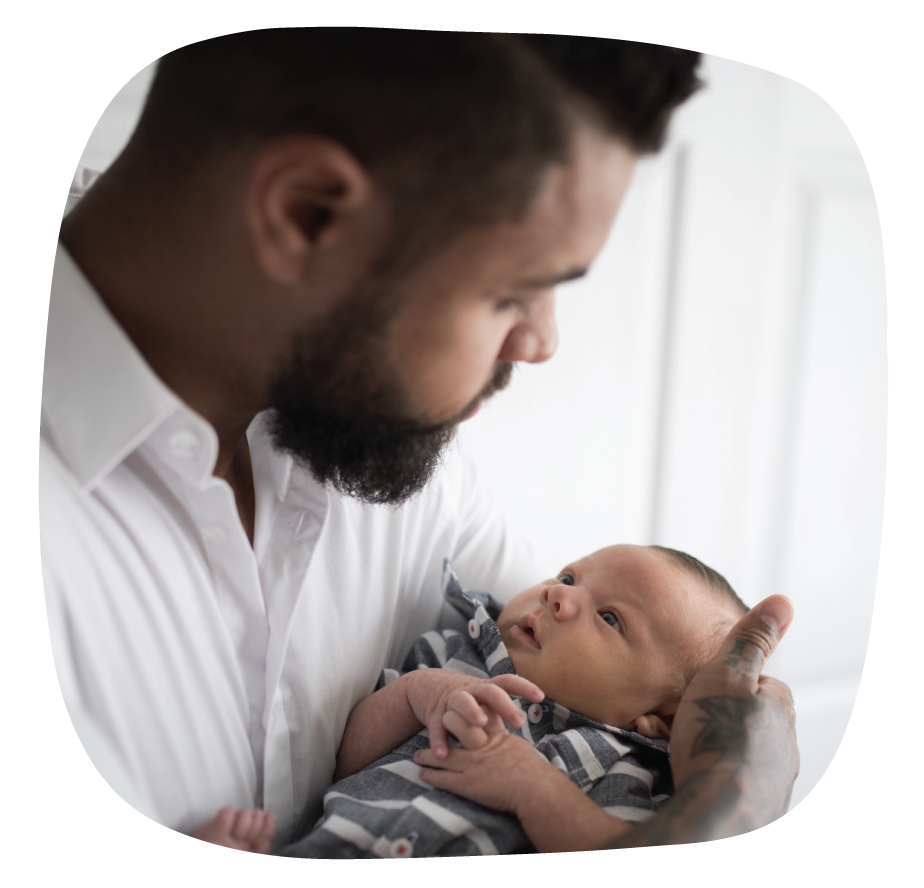
“Do Fathers Need to Have Paternal Instincts?”
By Junlei Li, PhD
As I was reading my colleague Thelma Ramirez’s reflections on maternal instincts, I wondered if there was such a thing as “paternal instincts” and how fathers develop their connections with children.
When I was becoming an adoptive father in my late 20s, I was very much hoping to have some “paternal instincts.” When my wife and I finally received the approval for our adoption application, the paperwork came with an inch-size photo of our would-be daughter. I remember scanning and enlarging that small photo and leaving it on my car dashboard, pasting it on the bathroom mirror, and making a stick figure of approximate child height on our fridge door. During the final few months of waiting, I would often stare at the picture and imagine what it would be like to build a relationship with a 2-year-old. I was intermittently confident — I shared my future daughter’s ethnicity and happened to also be studying child development in graduate school — and uncertain, wondering if anything I’ve learned on paper or in the abstract would be helpful in real life.
When the day finally came to meet my daughter — and for her to meet us — the so-called instincts seemed to kick in reciprocally between my wife and my daughter but not between my daughter and me. She was downright frightened of me. I had talked with enough adoptive parents in our community to know that initial preference for one parent over another is very common and even healthy. But emotionally, with each passing hour and my seemingly not making progress in connecting with her (or for her to want to connect with me), it became increasingly more unsettling. What if I couldn’t become the father she needed, or wanted?
Fatherhood in the 21st century comes in a wider and more diverse spectrum than ever before: fathers within marriages; fathers without marriages; gay and straight fathers; birth, adoptive, and stepfathers; and father figures who are one or two steps removed but no less involved in the lives of children. Fathers spend more time with their children than ever before. While still doing less caregiving than mothers, fathers are more involved in routine everyday caregiving than they were in the past, with African American fathers spending the most time on their children’s daily care. Fathers’ roles have expanded beyond the stereotypical breadwinner and stern disciplinarian to include coaches, teachers, nurturers, playmates, and many more.
At the same time, it is not uncommon for some fathers to feel uncertain of their role and impact on a child’s life, and whether people around them — partners, spouses, families, community, and even professionals — see them as the equal and important parents they are and want to be. “I want to be there for them” is a universal desire of fathers, even if “being there” takes on many different forms and may require overcoming a wide range of social, economic, and familial barriers.
What was so helpful to me during the first days, weeks, and months of fatherhood was the support I received from the people all around me. My wife had much empathy for my uncertainty and reassured me that the connection would come with time and patience. Our adoption social worker, who was herself an adoptive parent, introduced me to her children and made sure to tell me that her daughter (then 3) “thinks you are her best friend!” Our loosely organized community of adoptive families — including new fathers like me and more experienced fathers with grown-up adoptees — shared their ups and downs and the varied trajectories of connecting with their children. Even the orphanage caregiver who brought the child to meet us told me that it was very typical for children to be afraid of men because the only men they’ve met were doctors who examined and immunized them.
In our recent report on Early Relational Health (ERH), two principles focused on the support systems grown-ups need to build relationships with young children: “It takes a village” and “Build parallel relationships.” For fathers to grow and become wise fathers, being surrounded by a supportive and caring village of people is what helps us bring the parallel experiences we have with other adults into our connection with our children.
Unlike birth mothers, whose physiology and neural networks pre-wire themselves to be ready for parenthood starting with pregnancy, fathers’ neural networks and physiology seem to transform most dramatically after the child’s arrival, through routine caregiving and “being there” for and with the child. These emerging neuroscience findings with both birth fathers and adoptive fathers affirm a third principle highlighted in our report: that connections are built through simple, ordinary, everyday interactions. That is exactly what fathers of all types in all sorts of arrangements are doing more and more in the 21st century. We can all support fathers to have more opportunities to engage in these moments. We can offer reassurance and encouragement for fathers’ roles in everyday caregiving.
“I want to be there for them” is a universal desire of fathers, even if “being there” takes on many different forms and may require overcoming a wide range of social, economic, and familial barriers.
With the support of my circle of supportive adults, the connection between my daughter and me did grow little by little from the first few days into the first few months. It happened through the simple, ordinary interactions occurring in everyday moments. At first, my daughter got used to my being in the same room with her, so long as Mom was also there. Then my daughter tolerated my picking her up, so long as it was clear that I was taking her to Mom. Gradually, my daughter would take a broken toy or bag for me to fix (admittedly, we purposefully gave her things that “broke” easily): She would approach me tentatively, hand me the toy quickly, take a few steps back, watch intently, and take back the fixed toy and go back to her playing.
Later, she would talk to me on the phone while I was at work, more fascinated with the voice inside the phone than with me on the other end. And at last, I enjoyed the moment that so many parents cherish and remember — I waited outside her preschool to pick her up, and when the door opened, she ran and leaped onto my lap just like all the other children jumping onto their parents’ laps. What eventually looked natural and instinctive between my daughter and me grew out of these simple, sometimes awkward, everyday interactions.
Fathers grow as our children grow. We need opportunities to be there for the small, everyday moments. We need encouragement from people we trust in our “village,” including mothers, others, and other fathers. We can learn to do ordinary things with careful intention, even when doing so doesn’t feel intuitive — especially when it is not.

Junlei Li, PhD, is the Saul Zaentz Chair in Early Childhood Education at the Harvard Graduate School of Education as well as a Nurture Connection Steering Committee member. He has previously talked with us about principles of ERH; the essentiality of centering connection, growth, and healing in relationships; and how discord can be a pathway for relational repair, growth, and healing — both within ERH and this present moment. His research and practice focus on understanding and supporting the work of helpers — those who serve children and families on the front lines of education and social services. Dr. Li studied and learned from a wide range of developmental settings with low resources but high-quality practices, including orphanages, childcare, classrooms, and community youth programs. He developed the Simple Interactions approach to help identify what ordinary people do extraordinarily well with children in everyday moments and made that the basis for promoting positive system change.

“The Shock and Beauty of Early Parenthood”: Early Relational Health Experts Reflect on Caregiving Journeys, Including Their Own is a collection of stories from Nurture Connection, a national catalytic network devoted to promoting strong, positive, and nurturing early relationships to build healthier, more connected communities.
The stories are written by Thelma Ramirez, Ed.M, and Dr. Junlei Li, PhD, of Harvard University, who both work in the field of early childhood and relational health and who are both parents themselves. These narratives offer an intimate glimpse into how skilled early relational health practitioners help families navigate the challenges of parenting, sharing their own obstacles along the way.
Read the Full Series

“We Were Not Meant to Do This Alone”: Why We’re Reflecting on Our Own Parenting Journeys by Junlei Li, PhD & Thelma Ramirez, EdM
“Fathers Are Fathers – And So Much More” by Thelma Ramirez, EdM
“You and Your Child: How Many Interactions Are Enough?” by Junlei Li, PhD
“There Is No Magical Switch — It Takes a Village” by Thelma Ramirez, EdM
“Where Is My Maternal Instinct?” by Thelma Ramirez, EdM
“Do Fathers Need to Have Paternal Instincts?” by Junlei Li, PhD