As a field catalyst for Early Relational Health (ERH), Nurture Connection is excited to share this free animated video learning series, developed in partnership with Michigan’s Infant and Early Childhood Mental Health Consultation. The learning series — “Early Relational Health Together” — was co-designed with parent leaders and families to elevate the importance of simple but effective practices and interactions that support healthy relationships between babies, toddlers, and their caregivers.
This relational approach of listening deeply and partnering with families to co-develop resources that resonate with parents, caregivers, and providers across a range of spaces and care settings is what makes the “ERH Together” learning series so special. By creating more shared understanding and connection across systems, together we can support the kinds of reflective conversations and everyday interactions that are needed to help nurture ERH — and the flourishing of children, families, and communities.
Mary Mackrain (consultant with the Michigan Department of Health and Human Services) spearheaded the development of this series. Nurture Connection Family Network Collaborative (FNC) parent leaders Steven Thibert and Mia Halthon Jones, along with Regine Cherry (FNC parent) and Bryn Fortune (Nurture Connection Ambassador for Parent Partnership), participated in the parent codesign process. Read on to hear more reflections from Mary on the series’ development and hopes for how families and providers can use this learning series.
Reflecting Forward:
Strengthening Relational Connections
with “Early Relational Health Together”
By Mary Mackrain, PhD, IMH-E® (IV)
Background and Origins of How This Work Started
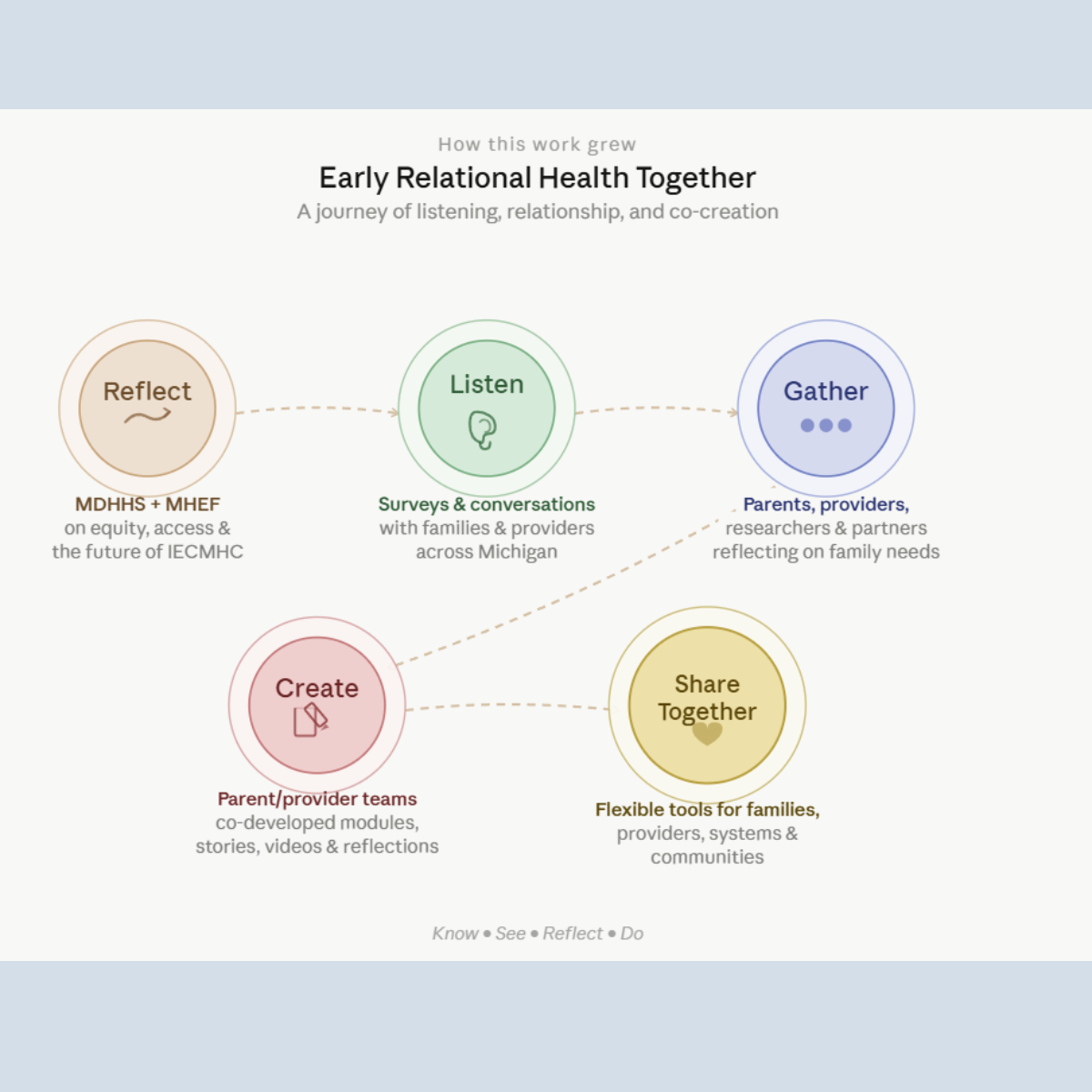
This learning series grew out of a broader effort between the Michigan Department of Health and Human Services (MDHHS), Bureau of Children’s Coordinated Health Policy and Supports, and the Michigan Health Endowment Fund (MHEF) to reflect on the future of Infant and Early Childhood Mental Health Consultation in Michigan, especially questions around equity, accessibility, and whether families truly experience services as supportive, meaningful, and relationship-centered, and if not, what can we do differently. Michigan teamed with the Indigo Cultural Center for evaluation, and the results of a survey and focus groups were informative. One of the results was a recognition that stigma around mental health is still quite strong, so we began to wonder, How can we work across systems with families and providers together to make an impact?
As part of wondering about these results, we realized we needed to go directly to the field and listen more deeply. We wanted to better understand the why of families’, caregivers’, and providers’ feelings and experiences with mental health promotion and prevention services; what was working; what was missing; and what their hopes were for themselves and the children in their care.
Instead of assuming we knew the answers, we wanted families and providers to help shape the direction. At this time, we were able to continue our work forward with MDHHS and the MHEF and integrate support from our federal Preschool Development Grant Birth through Five (PDG 0-5) efforts in Michigan. This enabled us to have funds to engage partners from Nurture Connection, including project advisers David W. Willis and Patsy Hampton, as well as families. Together we developed and disseminated a survey with families and had over 3,000 responses from Michigan providers and caregivers. It was these results that led us to the idea to develop an early relational series to get us all grounded in why early relationships matter so deeply to us all. We learned that families wanted us to notice the good spots in their caregiving and that providers were not getting some foundational information on how to partner with families around relationships. We also learned that everyone touching the lives of families mattered to their well-being and that small tips make a large impact, like making information digestible and visual!
Personally, after many years of working alongside families, I have seen over and over how powerful early relationships are. What stands out just as much is what happens for the caregiver in those moments of connection. Sometimes it is a parent calming together with their baby after a hard moment, snuggling while reading a book, or sharing eye contact and smiles during bath time. Those small, everyday moments can create glimmers of confidence and connection, and well-being for both the child and the adult. These experiences may seem basic but are actually so extraordinary in what they produce when they are affirming and positive.
One of the strongest messages we heard from parents was that they want people to notice what is going well. They want encouragement, celebration, and trust in their ability to know, love, and relate to their child. Families shared that they do not always need more advice or fixing. They want relationships and services that help them feel seen, capable, and hopeful. That feedback really shaped the tone and direction of this series.
“Instead of assuming we knew the answers, we wanted families and providers to help shape the direction.”
— Mary Mackrain, PhD, IMH-E® (IV)
Centering Parent Partnership in the Development Process
What happened next was really special. We continued our partnership with parents from the Nurture Connection Family Network Collaborative and professionals with Nurture Connection to help lead the development of the series. We wanted the process itself to be relational, reflective, and shaped by the people most connected to this work.
We brought together a diverse group for a full-day, in-person conversation, including parents of young children, researchers, evaluators, infant mental health leaders, and ERH partners from different backgrounds and systems. The goal was not to push an agenda but to provide questions that helped us to deeply listen, reflect together, and see what naturally surfaced when we centered relationships and family voices.
What really bubbled up was the importance of helping people better understand what ERH actually is — not as a program or a checklist, but as the emotional connection and sense of safety, trust, joy, and belonging that grows between young children and the people who care for them every day.
We also kept coming back to core values like humility, curiosity, celebration of strengths, cultural responsiveness, and truly partnering with families instead of positioning professionals as the experts with all the answers.
Another strong theme from our time together was that ERH is everyone’s work. Any provider supporting families with children from birth to age three, whether in childcare, home visiting, pediatric care, early intervention, mental health, or community settings, plays a role in strengthening relationships around young children. We talked a lot about how all these connections matter. When caregivers, providers, families, and communities partner together around relationships, they strengthen the protective factors surrounding the child.
After the in-person meeting, we created teams to work on each module of the series with larger group meetings to ensure we all agreed on content. Each team was led by a parent and a practitioner together. We also learned early on that visuals and stories resonated with both families and providers, so we worked with Next Day Animations to develop videos that could be embedded into each learning module. As we worked together, we kept asking ourselves, “What would actually help people connect this information to real life?” We did not want this to feel like a training where people sit and absorb information. We wanted families and providers to pause, notice relationships differently, and think about what connection looks like in everyday moments.
That is really where the structure of Know, See, Reflect, and Do came from:
Know is about building a simple shared understanding of ERH and why relationships matter so much in the earliest years.
See is about slowing down and really noticing moments of connection, joy, stress, repair, communication, and responsiveness between caregivers and young children.
Reflect is about making space for curiosity and self-awareness. We wanted both families and providers to think about their own experiences, relationships, culture, assumptions, and strengths.
Do is about taking small meaningful actions in everyday life. Not perfection. Just simple ways to strengthen connection during routines and ordinary moments families are already having together.
We wanted the series to feel human, reflective, visual, and hopeful rather than overly clinical. This series became less about teaching people something brand-new and more about helping us all reconnect with what relationships already make possible.

“Early Relational Health (ERH) is everyone’s work. We all play a role in helping young children feel safe, loved, understood, and connected.”
— Mary Mackrain, PhD, IMH-E® (IV)
Ways the Series Can Be Used
I really envision these videos being used in many different ways, because relationships happen everywhere children and families are. We designed the series to be flexible and approachable so families and providers can use it in ways that fit naturally into their everyday lives and work.
- For families, I hope the series feels positive, encouraging, and accessible. Parents told us they wanted more conversations about what is going well, more trust in their instincts and abilities, and more recognition that small, everyday moments matter. So these videos can be something families watch on their own, talk about in parent groups or home visits, or revisit during different stages of raising young children.
- For providers, I see the series being used during home visits, reflective supervision, team meetings, staff trainings, pediatric or clinical settings, and community conversations. The modules were intentionally built around a simple “Know, See, Reflect, Take Action” process because we wanted people to not just learn information but actually pause and reflect about how relationships show up in their daily interactions with families and children.
Looking Ahead: Hopes for the Series
My hope is that this series helps families feel seen, valued, and supported in the everyday moments they already have with their babies and young children. So often families are given advice or told what they should be doing — but what we heard through this process is that families want connection, encouragement, and relationships where someone truly notices their strengths.
I also hope the series helps professionals slow down and reconnect with why relationships matter so much in the earliest years. ERH is not a new program or one more thing to do. It is a mindset and a value system that guides us to show up with curiosity, humility, hope, and presence for families.
Resources like this series help remind all of us that small moments matter. A smile, a shared laugh, comforting a child, repairing after stress — these everyday interactions build emotional wellness and resilience for both children and caregivers. This relates to one of the core principles of ERH: “Simple and everyday human interactions are ‘good enough’ early relational experiences.”*
I also hope the series helps create more shared language about the foundational nature of early positive relationships and partnership across systems. One thing that became very clear during the series development process is that ERH is everyone’s work. We all play a role in helping young children feel safe, loved, understood, and connected.
To me, one of the most important values of the series is that it does not position providers as the experts who come in to fix families. Instead, it encourages genuine partnership. Families bring deep knowledge of their children, culture, strengths, and lived experiences. Providers bring support, reflection, encouragement, and resources. When those relationships are built on trust, curiosity, humility, and shared purpose, children benefit, caregivers benefit, and providers benefit, too. As the title states, it’s Early Relational Health — Together!

“At its heart, this series is really an invitation for all of us to slow down and recognize the power of relationships and the importance of showing up for one another in human ways.”
— Mary Mackrain, PhD, IMH-E® (IV)
Explore the full ERH Together Learning Series:
ERH Together: Learning Series Overview
Module 1: What Is Early Relational Health?
Module 2: What Are the Core Values of Early Relational Health?
Module 3: “We’re On The Same Team”
- Access the ERH Together Learning Series modules in Spanish at this link.
- Learn more about Michigan’s Infant and Early Childhood Mental Health Consultation (IECMHC)
 Mary Mackrain, PhD, IMH-E® (IV), is a nationally recognized consultant in infant and early childhood mental health (IECMH) systems with over two decades of experience supporting the Michigan Department of Health and Human Services (MDHHS) and other states nationally, in building quality infant and early childhood mental health services and supports across child care, home visiting, and early childhood initiatives. She also serves as a strategic adviser at the Education Development Center (EDC), where she supports federal and state partners in advancing maternal and child health initiatives. Mackrain is a coauthor of the Devereux Early Childhood Assessment (DECA) and has published and presented widely on topics including maternal depression, trauma-informed care, IECMH, and relational health. She holds a PhD in Early Childhood Education, Human Development and Child Studies from Oakland University, an MEd in educational psychology from Wayne State University, and a Level IV Policy Endorsement in Infant Mental Health from the Michigan Association for Infant Mental Health.
At its heart, Nurture Connection is an engaged, insightful community of parents, caregivers, researchers, medical professionals, philanthropists, early childhood systems leaders, and policymakers dedicated to ensuring every child has strong, nurturing relationships during their earliest, formative years.
Our “Reflecting Forward” series features guest articles and reflections by dedicated members of our national network, from across the country — who are advancing the Early Relational Health field through practice, research, and parent leadership. These reflections pave paths forward for transforming early childhood systems and imagining new possibilities for children, families, and communities.