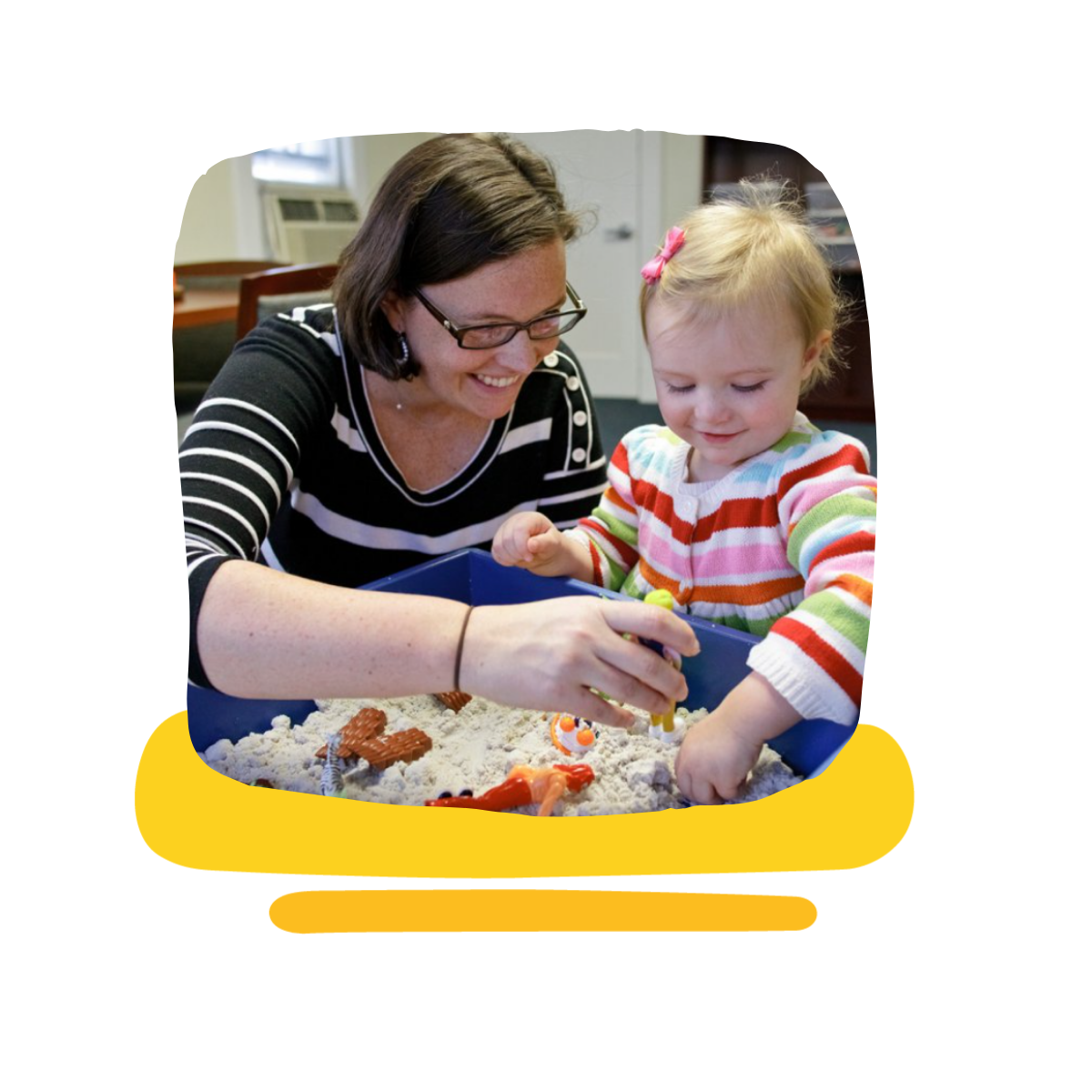
Above: Dr. Kaitlin Mulcahy working with a young client in 2012 (courtesy of Montclair State University)
Support for the emotional health of babies and children is fueled by a wealth of sources, from foundations and community groups to crusading legislators and investigative reports. There are also pivotal moments that redefine our thinking about Early Relational Health (ERH) and what is possible. New Jersey is a key example: The state’s funding for early relationships initially came in response to Superstorm Sandy, a devastating 2012 tropical cyclone that slammed into the Caribbean and the mid-Atlantic and northeastern United States, including 10 counties on the Jersey coast.
The 80-mile-an-hour winds and storm surge destroyed nearly 350,000 homes in New Jersey and caused $30 billion dollars in damages, leaving nearly 40,000 residents unable to return to their homes for months. But the superstorm also underscored the importance of relationships — and the opportunity for more social supports. The disaster funds that eventually rebuilt New Jersey also gave birth to an innovative state outreach initiative for infant and child health, recalls therapist Kaitlin Mulcahy, PhD, LPC, IMH-E, a leading voice in New Jersey’s ERH initiatives.
Earlier this year, early childhood advocates in the Garden State celebrated a historic victory: Then Governor Phil Murphy signed landmark legislation to improve access to preventive behavioral health services for children.
Under the new law, counseling, family guidance, and education as well as brief intervention services can be billed to Medicaid and state-regulated commercial health plans using at-risk screening (or Z codes) — all without requiring a formal psychiatric diagnosis.
“Under the previous rules, my primary care colleagues could not bring me in to consult until a child or adolescent already met criteria for an anxiety disorder or another psychiatric diagnosis,” said Jennifer Mautone, PhD, a pediatric primary care psychologist and director of the Pediatric Research Consortium at Children’s Hospital of Philadelphia (CHOP), in a press statement.
“Allowing clinicians, like me, to capture real-life stressors and risks to inform treatment, is a simple change that can be truly transformative,” Mautone said. “It will let us respond earlier, reduce stigma from premature diagnoses, and help children and families get the right care before challenges turn into crises.”
Keeping Babies and Children in Mind
Mulcahy helped organize the planning committee for the emerging New Jersey ERH Coordinating Council. She is also the director of the Center for Autism and Early Childhood Mental Health at Montclair State University, which is nestled on the east slope of the Watchung Mountains with a view of New York City in the distance. Several years ago she testified before the state legislature that babies in distress are often overlooked in policy and mental health. More recently, in January 2026, she testified in support of the passage of the new preventative behavioral health legislation. Thanks to the hard work of Mulcahy and her colleagues, New Jersey has taken a leading role in promoting strong, reciprocal bonds between infants and young children and the people who care for them.
The disaster funding earmarked for the state’s infant and child mental health program was propitious. In the wake of the hurricane, Mulcahy and her colleagues were increasingly concerned. “Many, many childcare centers were flooded and destroyed, but folks did not seem to be talking about the impact of the superstorm on infants and young children,” she tells Nurture Connection.
The day after the storm, she and her mentor Gerry Costa, PhD got on the phone with colleagues “to invite them to gather to talk about the impact of trauma on young children.” At the time, Costa was the director of the Center for Autism and Early Childhood Mental Health; Mulcahy was the associate director.
These talks led to the creation of a three-hour workshop on young children and trauma, which Costa and Mulcahy offered to colleagues who had contact with organizations that supported young children affected by the storm. “We said, ‘This is free for you to utilize. Go out, tell everybody about it, explain it, train with it anywhere and everywhere you’d like.”
Mulcahy and the New Jersey Association for Infant Mental Health then took the lead on mobilizing Head Start and other stakeholders to support the emotional health of babies and children after the catastrophe. Thanks to a champion in state government, Sunday Gustin, who had the idea of using FEMA dollars to not just help the state physically rebuild but also to support the awareness of professionals on the impact of trauma on infants, young children, families, and communities, Costa, Mulcahy, and their colleagues at Montclair State University expanded the 3-hour workshop to a 21-hour series called Keeping Babies and Children in Mind.
Twelve years later, Mulcahy is pleased that Keeping Babies and Children in Mind is still going strong.
Each session, she says, covers guiding principles of infant and child mental health for anyone who works with children under the age of eight. “We’ve trained over 10,000 people, and it really raised up an understanding of the importance of early experiences of trauma,” she says. “The climate is really ripe for this conversation.”
“We Start with Safety First”
The Center for Autism and Early Childhood Mental Health at Montclair State University, which is helping to lead this conversation, is devoted to supporting and strengthening the relationship between infants and children and their caregivers — a basic tenet of Early Relational Health (ERH).
“This is where New Jersey is slightly different,” Mulcahy says. “We’ve never solely focused on the adversity framework, instead realizing that the upstream impact of prevention would be more efficient and effective. What is often missed in the discussion of ACEs [adverse childhood experiences] is that it tells you how to address an adult post-trauma. We’d like to see the conversation expanded to focus on preventing adversity in childhood in the first place. And we do that through promoting strong, positive, and nurturing relationships from the first moments of family formation.”
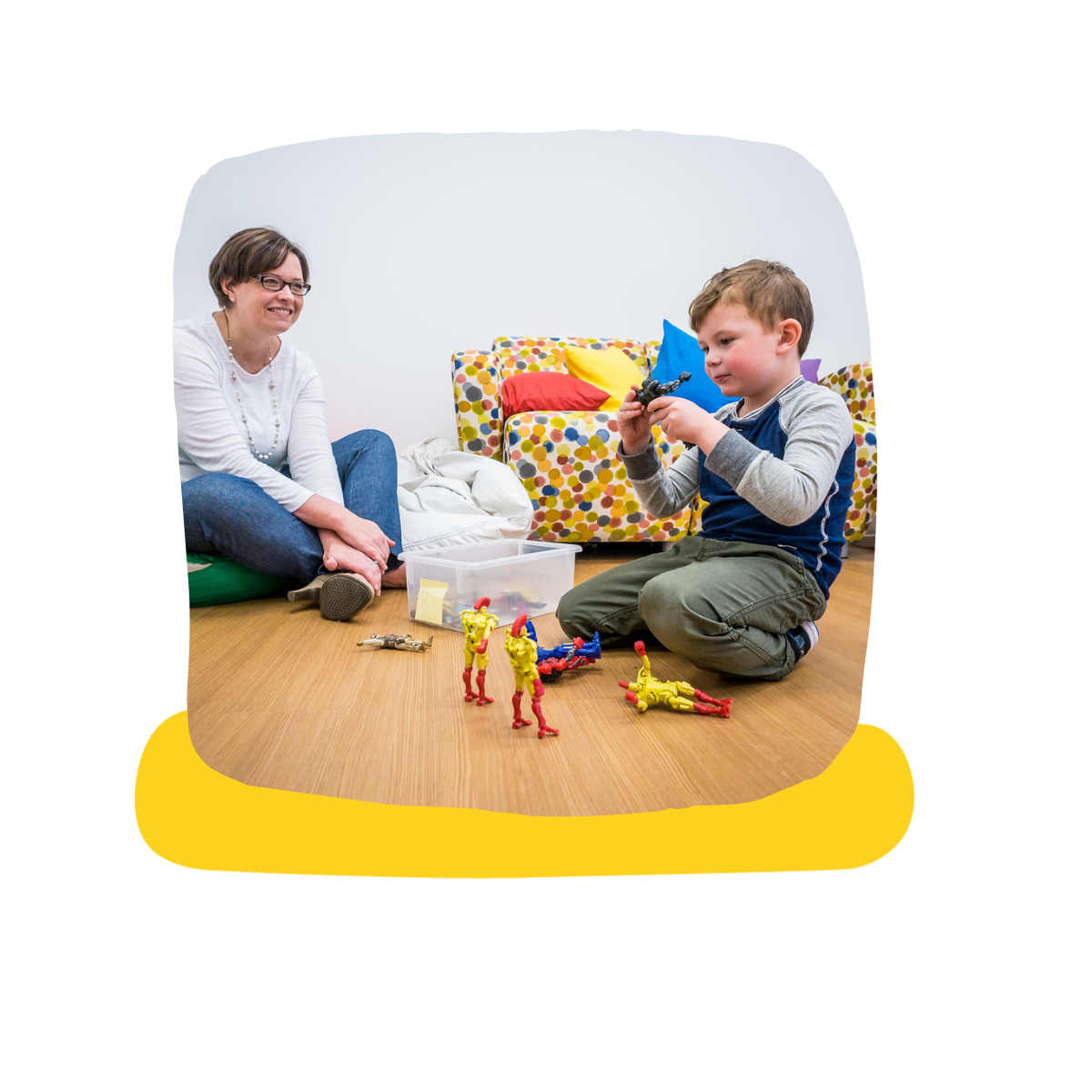
“We start with safety first — and how as humans we find safety through relationships.”
—Kaitlin Mulcahy, PhD, LPC, IMH-E
Director, Center for Autism and Early Childhood Mental Health, Montclair State University
The information about the profound importance of relationships “comes from the fact that a lot of us are still working practitioners,” she says. “Even if we’ve been at the state government or a programming level, we’re really informed by the lived experiences of families.
“I think New Jersey also benefits from being an incredibly diverse state informed by immigrant communities from all over the world,” she continues. “We have consistently tried to be sure that the population we’re speaking about and accompanying has a voice. It’s been a driving perspective of our work from the beginning.”
The Importance of Family Voices
Family voices were incorporated through funding the state received from the Pritzker Family Foundation, which went to the Advocates for Children of New Jersey.
“One of the outcomes was a parent leadership council that was very, very strong,” says Mulcahy. “We also have a statewide parent advocacy network, which is also very big.” It is led by Deepa Srinivasavaradan, she adds.
Working with the parent leadership council, Mulcahy and others recruited families to provide feedback to them in listening sessions. All told, 147 people sat in on the listening sessions, with 30 of them talking or providing feedback through text chats. What the agencies learned was not only eye-opening but also fundamentally transformative, helping to shift the way the state works with parents and caregivers.
It turned out that many families were distressed about the way providers approached them. One of the messages, she says, was about the culture of care, such as: “I would like information in my language; I would like people not to talk down to us; I would like to make sure people have cultural responsivity training.” Another comment illuminated a deep need for services that could prevent trauma and illness.
Besides training in empathy and cultural awareness and services in multiple languages, families wanted streamlined paperwork and better insurance coverage, as well as increased access to early childhood programs and healthier school meals.
The two core issues from the learning sessions revolved around dignity and respect, underscoring the point that families know what they need, such as: “I want to be treated like a human, and I want to be able to receive support before having a diagnosis, before the need to go to the ER, before things get terrible.”.
“It’s a really strong argument for preventive services,” Mulcahy says, “and not just for the preventive services, but being treated with the dignity that should be afforded every human being.”
Today, the Center for Autism and Early Childhood Mental Health continues to build systems of care through ERH training. For the past five years, it has worked on increasing understanding of ERH in its early intervention system for babies and children, in partnership with the state health department. The center has also recently been funded to provide all the relational health support across the state’s rural health transformation program.
“What rural health struggles with is isolation and turnover,” says Mulcahy. “So how do we fix isolation and turnover? Relational health! We’re talking about relationships as being important and a vital sign across the lifespan.”
Looking Ahead
The new Democratic governor of New Jersey, Mikie Sherrill — a former U.S. Congresswoman and Navy helicopter pilot — is also a youth mental health champion. Advocates for Children of New Jersey and the state’s Healthcare Quality Initiative are driving the ongoing work around youth mental health and the current behavioral preventive health benefit.
New Jersey believes that ERH “is everyone’s business and should be in everyone’s budgets,” says Mulcahy, adding that there is also a strong economic argument for a business case “based on the pandemic and having childcare be an essential service.”
The good news is that Early Relational Health is a common ground in New Jersey and a core practice across many different disciplines and members of the workforce, according to Mulcahy.
Whether employees work on initiatives in the Department of Health, the Department of Children and Families, or Human Services, she says, “that is the throughline — the core practice and common ground of advancing your work through relationships. Our goal in New Jersey ultimately is that every provider that interacts with a family, the provider has the same idea: that relationship matters and that the family leads.”
This blog post is part of Nurture Connection’s “ERH in Action” series of listening and learning sessions. Our network is full of meaningful examples of people and organizations promoting ERH in their daily lives and work. Our “ERH in Action” series highlights and uplifts stories from various fields to share learnings, challenges, and bright spots in the movement.
Explore More Stories of ERH in Action:
- Inside Illinois’ Early Intervention Training Program
- Where Joy Lives on Fridays: Celebrating ERH in Action with UCSF BLOOM
- Postpartum Support International (PSI) Makes Peer Connections Core to Perinatal Mental Health
- Promoting Teen Parents’ Relational Health with GLOW Children
- Child First: How a Relational Health Focus Can Drive Practice Transformation