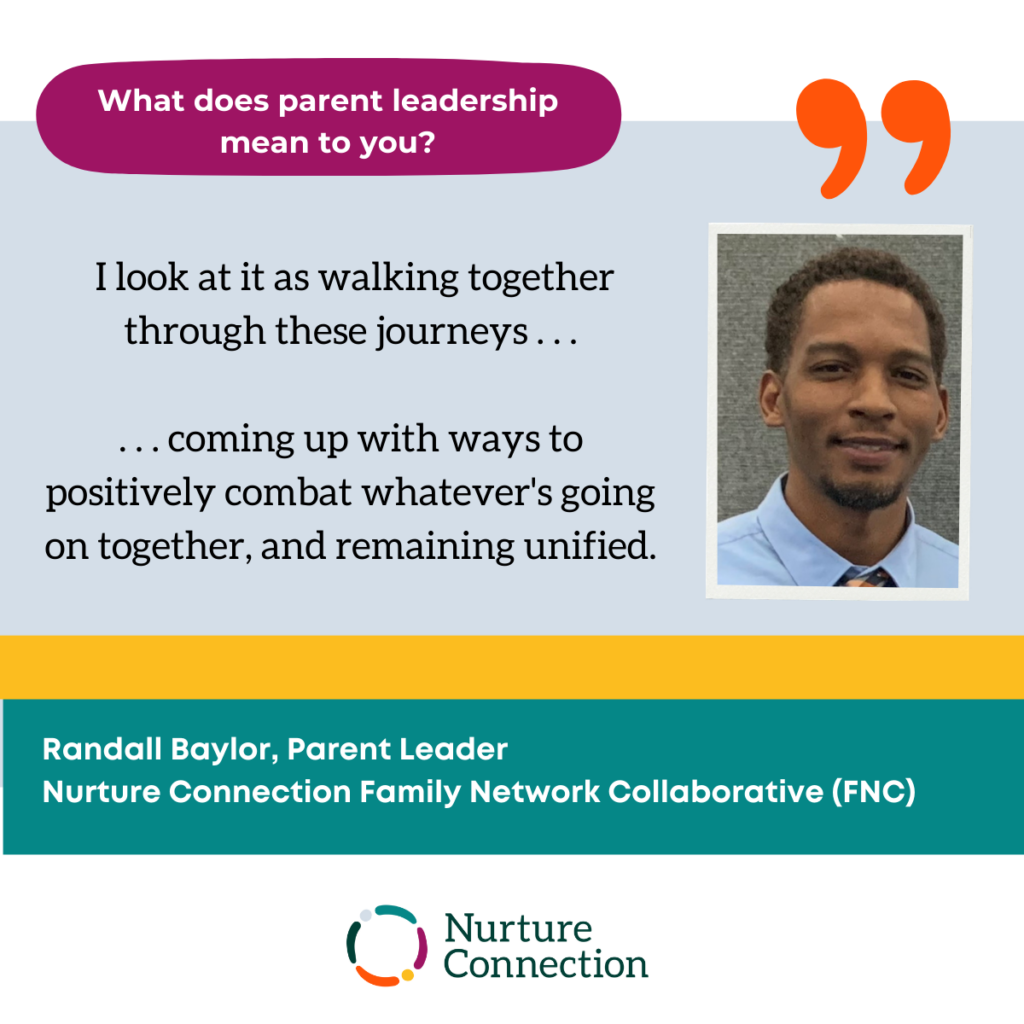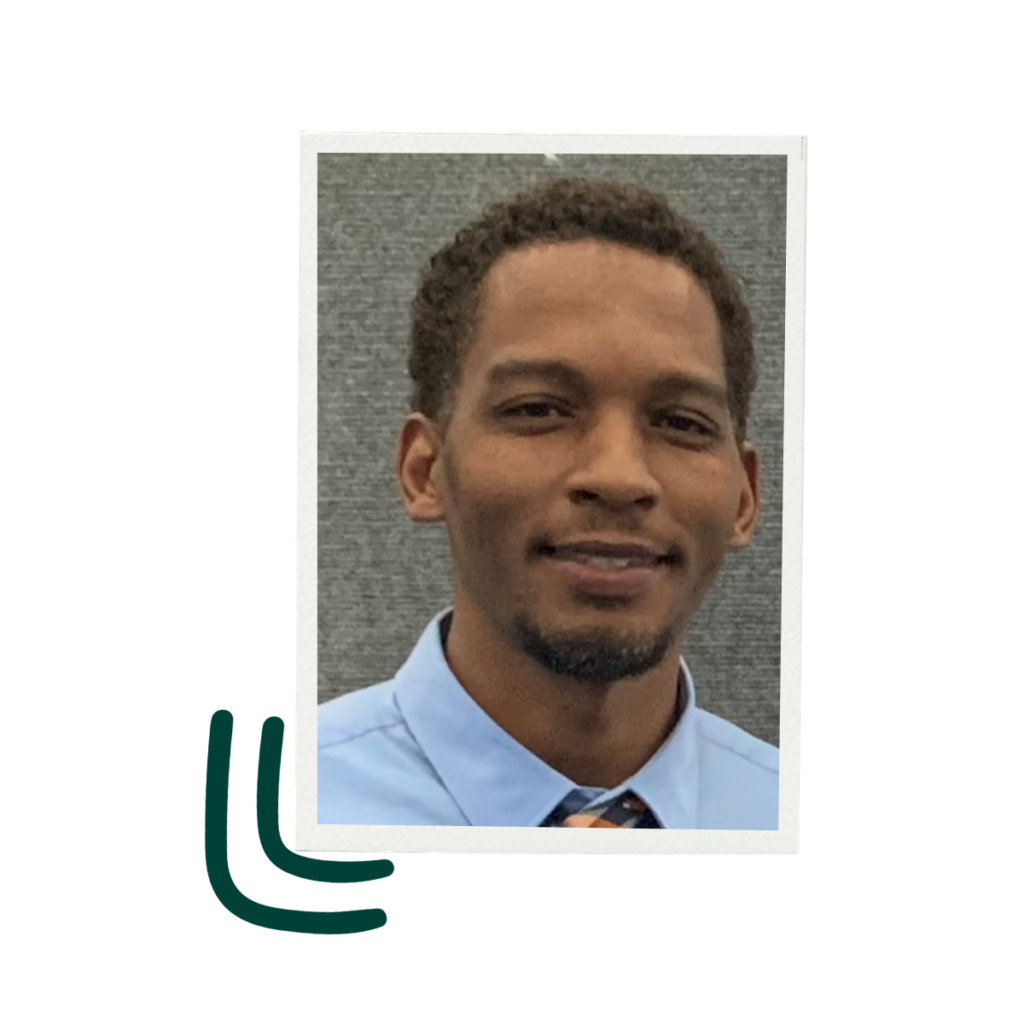
This month, Nurture Connection is excited to welcome a new parent leader to our Family Network Collaborative (FNC) — Randall Baylor! Born, raised, and currently residing in the District of Columbia, Baylor is a father of two and represents Black and Brown fathers of children between the ages of zero and three in the Washington, D.C., area. He also serves as a program manager for community mental health as part of the Early Childhood Innovation Network (ECIN) at Children’s National Hospital. Read on to learn more about Baylor’s journey into championing early relational health (ERH) as a parent leader.
In his work with families, Randall Baylor doesn’t shy away from good trouble. “I don’t accept ‘no’ when I feel a family should receive a ‘yes,’ let me put it that way,” he says. Since joining Children’s National in 2017 as a family services advisor under a pilot for the Healthy Steps program and later assuming a family services coordinator role, he’s worked in a clinical capacity with community members and helped reimagine the referral process for early intervention services for families with children between the ages of zero and three (in partnership with OSE Early Stages and Strong Start).
Connecting families to services for early intervention has been a critical journey in community engagement for Baylor, who has over 10 years of experience working directly with families and as a youth behavioral specialist. This can look like supporting families on the frontlines with workforce development, hosting parent cafés, and advocating for their needs through relationship building with community partners, as part of his role managing a community partner portfolio.
“Primarily the work that I’ve done has been centered around youth advocacy, community engagement . . . finding really unique ways of bridging the gap so families get connected and stay connected to services and supports that are most meaningful,” he says.
In one case, Baylor received a referral from a family trying to get connected with services for their young child with autism. “At the time, I really didn’t have much knowledge about autism, to be completely honest,” he says. He called around to the different departments to try to schedule an appointment for them, only to be told the next appointment would not be for another two and a half years. “What can we do in a situation like this? Two years is a whole prolonged period of time — of not understanding, of deepening concerns and an inability to connect [between parent and child]. It just didn’t sit well with me.”
Eventually he was able to reimagine the referral process by offering to do the autism intake appointment himself — drastically cutting down a two-year referral process to just 13 days.
“I’ve always advocated from a healthcare standpoint. And for me, there was a large gap in not only children getting connected with early intervention services, but families getting connected with behavioral health services, and the quality of those behavioral health services.”
The ERH Journey Is Personal
“Prior to joining Children’s National, even with my different experiences and knowledge [from] working with youth, if you asked me what ERH meant to me, I would’ve said something along the lines of all the positive ways that my grandmother stepped in, that my mother and father missed. After a few years working with this organization, I would tell you [that ERH means] the opposite of Adverse Childhood Experiences (ACEs).
“It’s so unique how things change in one’s life. I did so much frontline work for families with so many different diagnoses that have challenges getting connected with support. And with all of the work that I poured into working with families of autism, I never thought that I would have a child that was special needs or autistic.”
Once Baylor realized that he had a special needs child, however, he found his way forward. “For me now, ERH is about finding extremely deep and connected ways to develop relationships with your children . . . It’s really those ways to deeply connect, even if you cannot communicate.”
“See that’s the biggest thing, you know – how can you develop relationships and a meaningful bond and create these connectors with someone, when you take communication out of the picture?
It’s not that [my daughter’s] nonverbal; she can say words, but she’s not gonna hold the conversation with you currently. But I still have that connection. So for me, ERH is about making sure that I’m able to find a bonding and connecting way to understand my daughter outside of communication, and being her voice until she can utilize her own.”

“It’s all about the importance and value of the way that you treat people and the way that you care for them.”
—Randall Baylor, Parent Leader, Nurture Connection Family Network Collaborative (FNC)
Reimagining Systems Through Relational Health
Support for families also includes finding opportunities to improve how hospitals and other systems build relationships with families, Baylor says. “It’s really about inheriting the concern. As a healthcare organization, if there are things that are going on within your reach, or things that you could be more knowledgeable about, I think that that is hugely important for individuals that have the capacity and have the support to do so . . . we can always do better. Everyone can always do better. It’s all about intentionality.”
“Coming from D.C. and living in the city, I’ve seen more than enough examples of what families need and how things can end up [if they don’t receive it]. D.C. is a city that has a budget. I’m always going to hold my organization responsible, and I’m gonna hold the city responsible. That means testifying, advocating on my own professional behalf and my own experience on behalf of families . . . showing up to board meetings or having lunch with community leaders.”
Walking with Families and Looking Ahead
“I’m motivated to continue making good relationships,” Baylor says. “And through these good relationships, we’re going to hear some bad things. But we can make good out of some of these bad things and learn where we can apply these lessons going forward . . . in our children’s lives, and our nephews’ lives and our nieces’ lives; our little cousins and friends down the block, your neighbor across the street. It’s all about the importance and value of the way that you treat people and the way that you care for them.
“Some people may look at it as hand-holding — I look at it as walking together. I’m not walking in front. They’re not walking in the back. We’’re walking together through these journeys, and we’re coming up with ways to positively combat whatever’s going on together and remaining unified.”